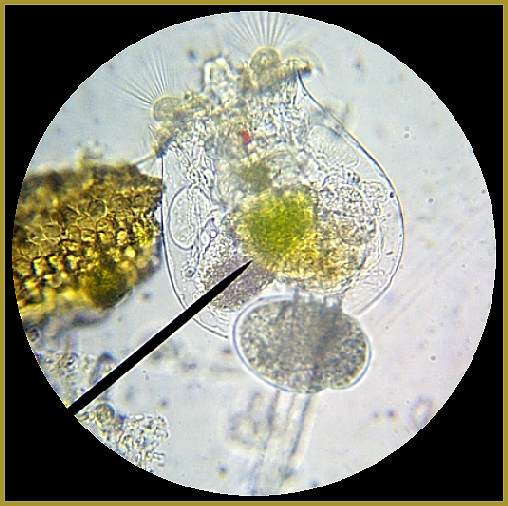
I found this critter while looking at some muck I picked up with an eye dropper from one of my lily pots. It's an unusually clear and detailed 400x image of a Rotifer, one of the smallest of the multi-celled microbes. They are common, are found wherever there is moisture or water and they come in a variety of shapes. They all have the "wheel organs", plainly seen at the top of the head, which swirl and channel food into their mouths. Hence the name Rotifer, meaning "wheel".

This species is one of the few where the internal organs can be easily seen, and this image shows most of them clearly. The contents of the stomach are visible, and the red spot at the center of the head area is a light-sensitive eye. They can't see with it, but can tell the difference between night and day, and the direction from which the light is coming. The additional bonus here is that this female is carrying an egg sac. When the eggs hatch they will provide food for other microbes, newly hatched fry, or if they're lucky - the young will grow to adults. Where they will provide food for even larger microbes.

Should the egg sac rupture for some reason (not uncommon), ravenous scavengers such as Coleps would descend on the eggs within seconds. The eggs would all be consumed in just a few more seconds. Even the aquatic microbe ecosystem has its Condors, Vultures and Hyenas.

Back To Image Index Page